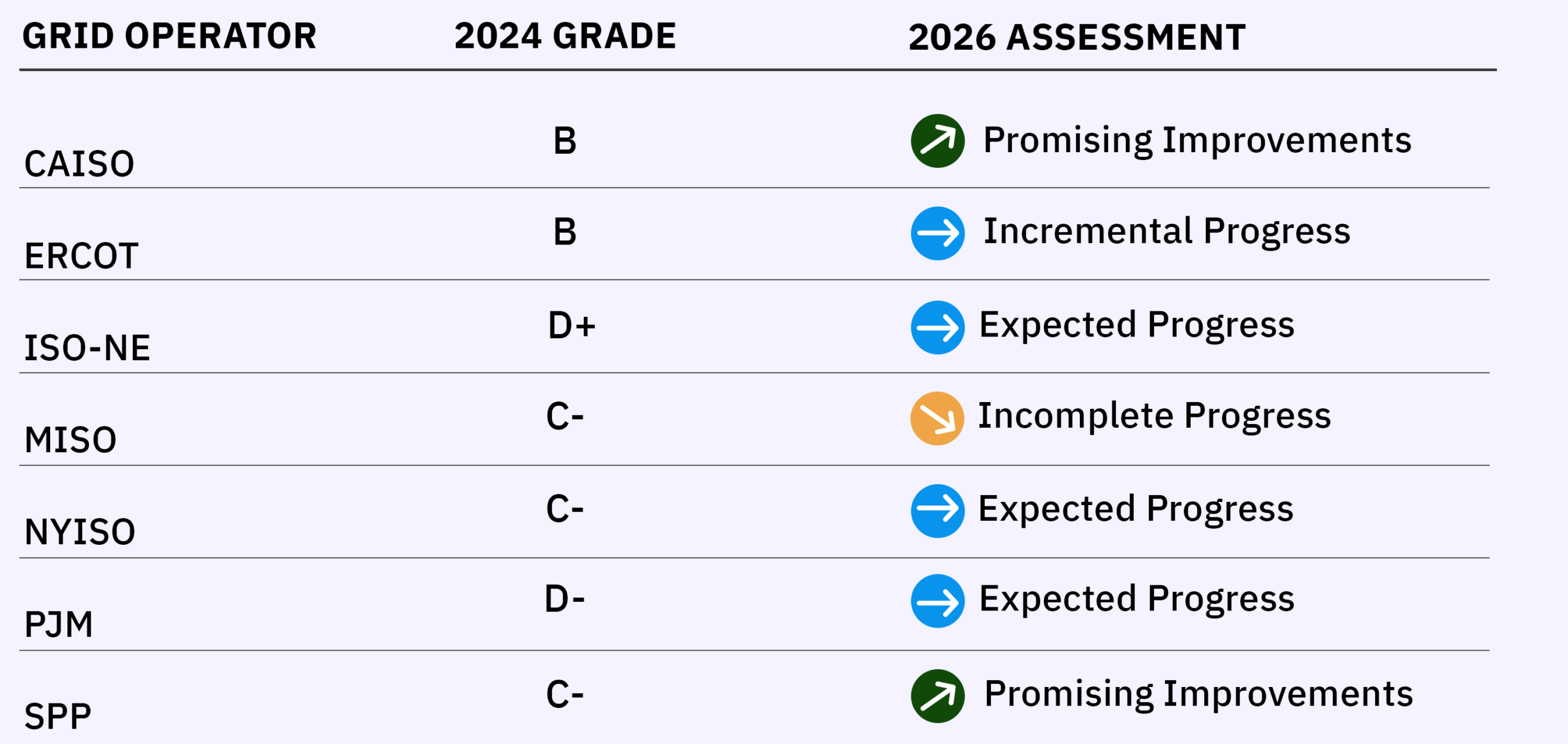
PRESS RELEASE: As energy prices rise nationwide, a new progress report evaluates regional efforts to fix the grid connection bottlenecks that are preventing energy supply from keeping up with growing demand.
The new progress report is an update of a 2024 scorecard, in which many interconnection queue processes led to C’s and D’s for allowing energy projects to get backlogged in years-long delays, with over a million megawatts worth of renewable power and storage projects stuck in antiquated interconnection processes, sending prices soaring and threatening reliability. The median time for a project to sit in an interconnection queue in 2025 was 60 months, up from 20 months in 2005.
This new progress report produced by The Brattle Group and Grid Strategies on behalf of the national business association Advanced Energy United finds that, thanks to a landmark order from the Federal Energy Regulatory Commission (FERC Order No. 2023) and efforts undertaken by grid operators, as well as sustained engagement from state leaders and the advanced energy industry along with its partners, most regions are making notable progress in addressing interconnection queue backlogs and planning process improvements. But it also finds that many of the issues identified in the original scorecard require further attention.
The progress report finds that grid operators have, with varied levels of success, cleared the backlog of projects waiting in line, while also preparing and implementing process changes for future review cycles of grid connections, many of which are just now underway. However, the quality of the progress being made ranges from “promising” and “expected” to “incomplete” and “incremental.”
“Grid operators are finally rowing in the right direction, but the waters remain choppy,” said Caitlin Marquis, Managing Director at Advanced Energy United. “Reforms are slow, delays are common, project withdrawal rates remain high, post-interconnection delays are both persistent and opaque, and fast-track work-arounds have primarily benefitted costly thermal-generation projects. We need to stay focused on fixing these project bottlenecks so that all regions of the country have enough power to meet growing energy needs.”
“In addition to complying with FERC orders, we’re seeing grid operators hiring more staff, improving project management tools, applying automation, increasing transparency, and improving coordination among transmission owners and interconnection customers,” said Michael Haggerty of The Brattle Group, one of the report authors. “This is a massive undertaking by the grid operators to account for the new way electricity sources are being plugged into the transmission system.”
“Grid planners are still laboring under processes that are unnecessarily complex,” said Rob Gramlich of Grid Strategies, another report author. “Recent innovations to provide much more certainty have the potential to speed the process and get needed generation connected, without going backwards on open access.”
FERC Order No. 2023 requires grid operators to move away from the “first come, first served” model of grid connection to a “first ready, first served” cluster process. The report authors and industry leaders say this approach change should be seen as the bare minimum of the reforms needed.
Report authors include the following policy solutions for improving interconnection across the country:
- Proactively planning capacity and prioritizing “most ready” interconnection requests utilizing a clear, predictable entry fee.
- Creating or updating processes for replacement of existing plants and making use of immediately available system capability.
- Identifying the most cost-effective solutions for resolving reliability violations.
- Leveraging automation to expedite interconnection studies.
- Improving reporting on the post-generator interconnection agreement transmission construction phase.
Consumers have been paying the cost of these bottlenecks. One analysis found that consumer electricity costs could have been reduced by as much as $7 billion dollars in one PJM capacity auction in 2024 had the grid operator’s interconnection process been working more efficiently. That report found that had PJM used a faster, simpler process to connect just 15% of the proposed projects waiting in line in its interconnection queue at the time that it likely would have led to more than 10 GW (gigawatts) in increased capacity.
The report and a fact sheet is available for download at: advancedenergyunited.org/interconnection-progress-report